

The 7-Stage
Loop.
Regenerative care is not a single appointment. It is a sequence, and the sequence repeats. Seven stages carry you from your first conversation through a full year of structured follow-up.
Stage seven does not end the process. It informs the next case review, which becomes stage one again, with a year of your own data behind it.
Free consultation with a care consultant, many of our care consultants are registered nurses. No sales reps. No receptionist.

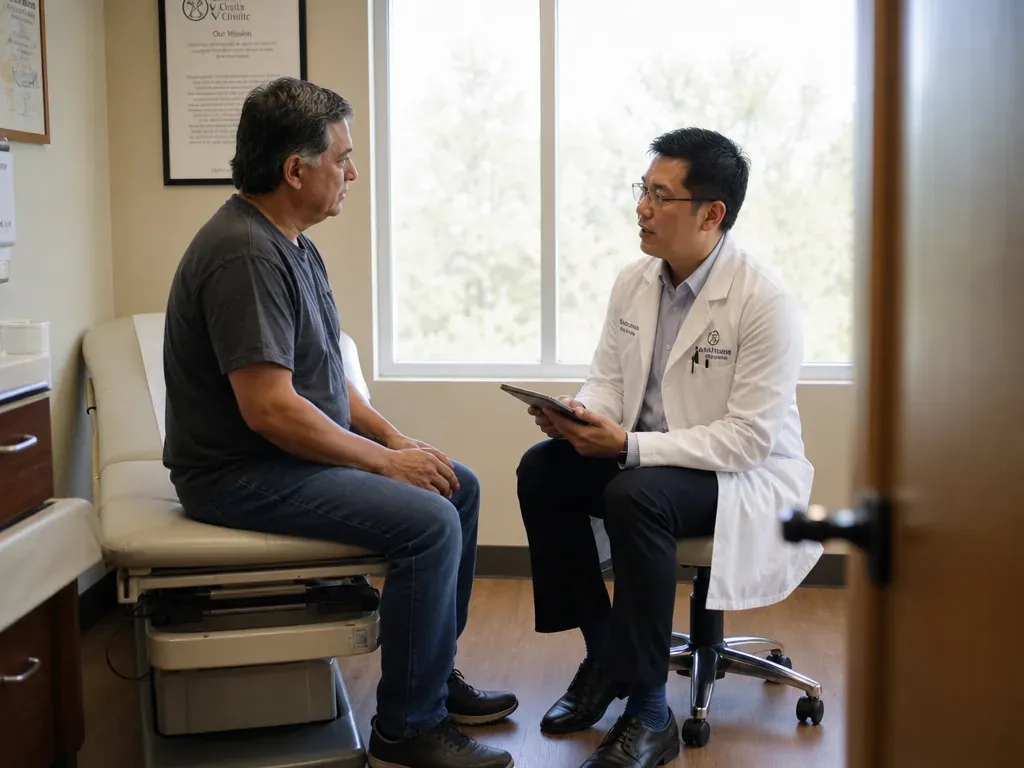
Understand Your Case
We begin with your health history, symptoms, previous treatments, available records, and the changes you are hoping to make.
The first conversation is not a sales call. It is a structured intake. A care consultant walks through what you are experiencing now, how long it has been happening, what has already been tried, and what actually changed as a result. That history matters more than any single test result, because it tells the clinical team how your body has responded to intervention in the past.
You will be asked for whatever documentation you already have, imaging reports, operative notes, labs, specialist letters, medication lists. If something is missing, we say so plainly instead of working around the gap. Incomplete information is one of the most common reasons a case should slow down rather than move forward.
We also ask what you are hoping to change. Reduced pain, better mobility, improved energy, slower progression, or simply a clearer answer. Naming the goal early gives every later stage something to measure against.
- Typical length
- 45–60 minutes
- You provide
- History, records, goals
- You receive
- An honest read on fit

Establish Your Baseline
Relevant blood work, biomarkers, imaging, and patient-reported measures help establish a clear starting point when clinically appropriate.
Learn more about TruDiagnostic baseline testingWithout a baseline, nothing that happens later can be interpreted. This stage exists so that any change you notice in month three or month nine can be compared to something real rather than to memory. When it is clinically appropriate, the team identifies which labs, biomarkers, and imaging are worth collecting, and which are not.
Patient-reported measures are collected alongside the objective data: pain scores, function, sleep, fatigue, mobility. These are the outcomes that matter to how you live, and they are recorded in a consistent format so they can be tracked over time rather than described anecdotally.
Baseline work also functions as a screen. Occasionally what it reveals is that a different specialty should be involved first, or that a candidate is not a candidate right now. That is a legitimate and useful outcome of this stage.
- May include
- Labs, biomarkers, imaging
- Also captured
- Pain, function, sleep
- Purpose
- A measurable starting point

Build Your Primary Protocol
Your clinical team evaluates which elements belong in your program, how they should be sequenced, and why each one has been selected.
A protocol is not a product list. The clinical team reviews your intake and baseline together and decides which elements are appropriate for your case, what order they should occur in, and how much time should sit between them. Sequencing is often as consequential as selection.
Each element carries a reason. You should be able to ask why a specific component is included and receive an answer grounded in your history, your measures, and the available documentation, not in marketing language. If the rationale for something is thin, it should not be in your plan.
This is also where the boundaries of the plan get defined: what it is intended to address, what it is not intended to address, what remains uncertain, and what would cause the team to change course. You review that framing before anything is scheduled.
- Reviewed by
- Your clinical team
- Defined
- Elements, order, timing
- Explained
- Rationale for each item

Coordinate Your Travel
You review the appropriate treatment locations in Mexico, expected timeline, travel requirements, and preparation instructions.
Once the protocol is settled, logistics become the work. You review which licensed locations in Mexico are appropriate for your program, what the schedule looks like day by day, how long you should plan to be away, and who will be accompanying you if that applies.
The two options differ in practical terms rather than in medicine. Tijuana sits inside an established medical district a short coordinated drive from San Diego, which keeps total travel time down. Tulum is reached through Cancún or Tulum international airports and supports a longer, quieter recovery window, with supportive modalities such as photobiomodulation, medical cold laser, biomechanics assessment, and in-clinic IV administration available on site when your plan includes them.
Practical requirements are handled in advance rather than at the border: documentation, ground transport, lodging near the facility, timing of arrival relative to your first appointment, and what happens if a flight moves. Preparation instructions, including anything to pause, adjust, or bring, are provided in writing.
Nothing about this stage should feel improvised. The point of coordinating travel carefully is that you arrive with your attention available for the procedure rather than spent on logistics.
- Locations
- Tijuana and Tulum
- Provided
- Day-by-day timeline
- Handled
- Transport and lodging

Complete Your Procedure
Before the procedure begins, you know what will be administered, where it came from, why it was selected, and what to expect on procedure day.
On procedure day there should be no surprises. Before anything begins, you are told what is being administered, what source documentation exists for it, why that specific option was selected for your case, and how the day will unfold from arrival to discharge.
The clinical staff walks through the expected experience: preparation, duration, what you will feel, what monitoring is in place, and what the immediate aftermath typically looks like. Questions are expected at this point, not discouraged.
Discharge is treated as part of the procedure rather than the end of it. You leave with written instructions, contact information, a description of normal recovery, and a clear list of the signs that warrant reaching out immediately.
- Disclosed
- What and from where
- Walked through
- The full procedure day
- At discharge
- Written instructions
Integrate and Monitor
Your recovery guidance, check-ins, and follow-up data help the clinical team interpret how your body is responding.
The weeks after a procedure are where a plan either gets supported or gets abandoned. Recovery guidance covers activity, load, sleep, nutrition, and anything to avoid during the window when your body is doing the work. It is specific to your protocol rather than generic.
Scheduled check-ins bring information back to the clinical team. Repeated patient-reported measures, and repeat labs or imaging where appropriate, are compared directly to your baseline so response can be read as a trend rather than guessed from a single moment.
Interpretation is the point. Some responses are early, some are gradual, and some indicate the plan needs adjusting. Monitoring exists so that adjustment happens on evidence and on schedule instead of in reaction to a bad week.
- Cadence
- Structured check-ins
- Compared to
- Your original baseline
- Result
- Adjustments on evidence

Support Your Healthspan
Quarterly reviews over 12 months help clarify what has changed, what still requires attention, and what your next phase of care should consider.
The final stage is the longest. Over twelve months, quarterly reviews look at the whole arc: what improved, what plateaued, what did not respond, and what new questions emerged. The comparison is always against your documented baseline.
These reviews are also where durability gets assessed. A change that holds at three months and a change that holds at twelve months are different findings, and only the second one tells you much about the value of what was done.
By the end of the year you should have a clear view of your current position and what your next phase of care should consider, whether that is maintenance, a different specialty, a further intervention, or simply continued monitoring. That view is what returns you to the beginning of the loop.
- Duration
- 12 months
- Cadence
- Quarterly reviews
- Output
- Your next phase of care
The loop does not
have an endpoint.
When the twelve-month review closes, what you have is a new baseline, a documented response history, and a clearer set of questions. That becomes the intake for your next cycle. Stage seven feeds stage one, and the process begins again with more information than it had the first time.
Start at stage one.
The first stage is a conversation about your history, your records, and what you are hoping to change. Nothing is scheduled until you understand the plan.
Free consultation with a care consultant, many of our care consultants are registered nurses. No sales reps. No receptionist.