
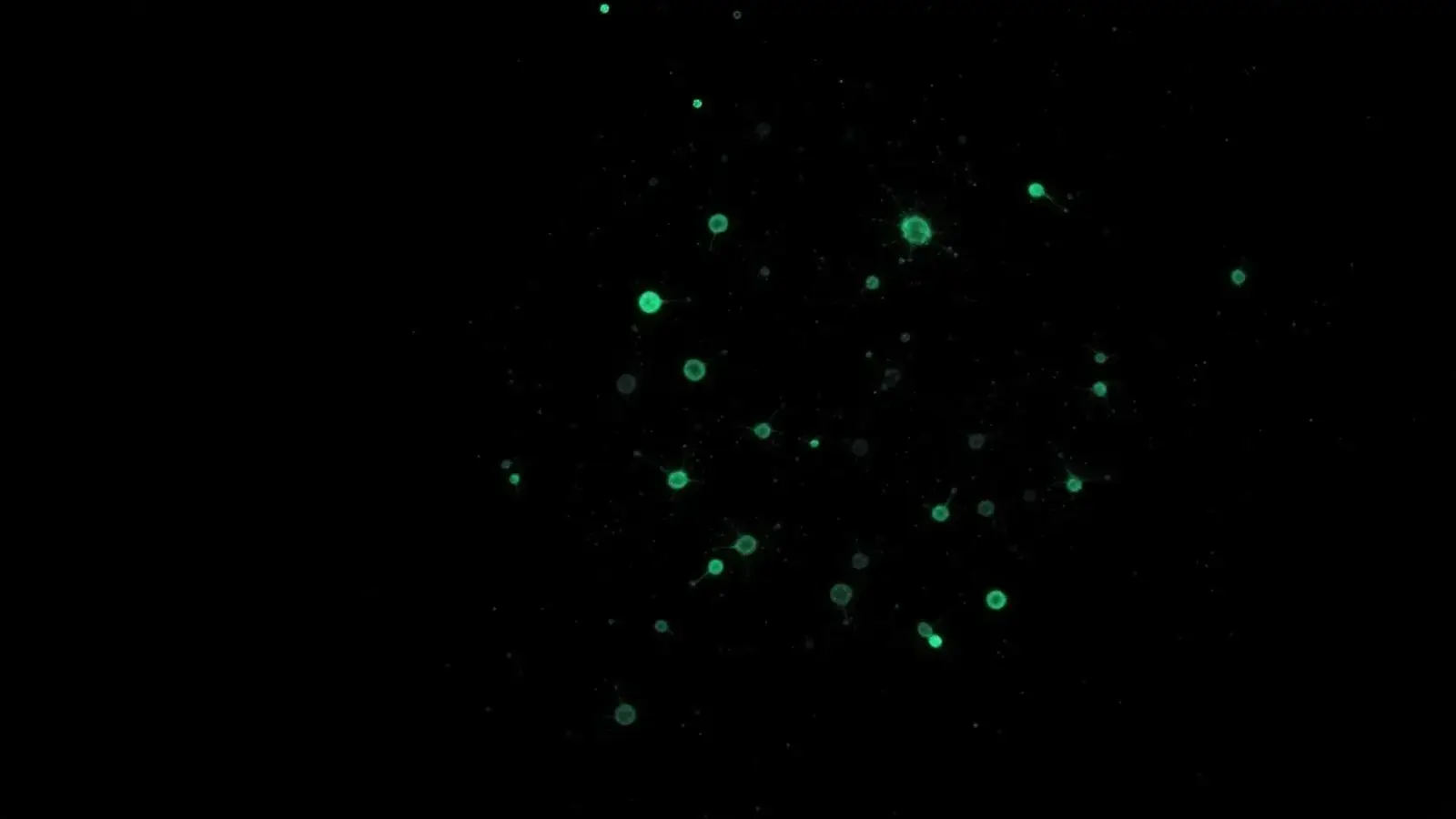
What Muse cells are, and why the source is the whole question.
Muse stands for multilineage differentiating stress enduring cells. They were identified in 2010 by Dr. Mari Dezawa, MD, PhD, at Tohoku University in Japan, and published in PNAS that year.
This page explains what these cells are, who MuseCell Innovations is, and why an unverified "Muse" claim means very little on its own.
Dezawa MuseCells are not approved by the FDA for any indication in the United States, and the human clinical evidence is still emerging.
What Muse cells are.
They are a rare subpopulation living within a standard mesenchymal stem cell population, roughly one to three percent of it, identified by the SSEA-3 surface marker.
Muse cells carry pluripotent-like markers, meaning they are capable of becoming a wide range of cell types across all three germ layers, including nerve, heart, and organ tissue. They are also drawn toward dysfunction. Damaged tissue releases a signaling molecule called S1P, and Muse cells detect it through the S1PR2 receptor, homing toward the source under their own power rather than waiting to be placed.
Free consultation with a care consultant, many of our care consultants are registered nurses. No sales reps. No receptionist.
Dezawa MuseCells compared with standard MSCs.
Standard MSCs
Dezawa MuseCells
What they are
Standard MSCs
Multipotent adult stem cells from bone marrow, fat, or umbilical cord, identified by a defined set of surface markers (CD73, CD90, CD105).
Dezawa MuseCells
A rare subset within MSC populations, about 1 to 3 percent, identified by the SSEA-3 marker.
Differentiation range
Standard MSCs
Multipotent, limited to related tissues such as bone, cartilage, and fat.
Dezawa MuseCells
Pluripotent-like. Studied across all three germ layers, including nerve, heart, and organ tissue.
Distribution after IV
Standard MSCs
Largely first-pass to the lungs.
Dezawa MuseCells
Studied as homing to the target tissue via the S1P signal and S1PR2 receptor.
Immune profile (donor cells)
Standard MSCs
Immune rejection reported in the literature.
Dezawa MuseCells
Described as immune-privileged; MCI reports no immunosuppression required.
Evidence base
Standard MSCs
The most studied cell therapy, with a large track record across many conditions.
Dezawa MuseCells
Emerging. 120+ peer-reviewed publications since 2010, with human trials in stroke, myocardial infarction, and spinal cord injury.
A standard mesenchymal preparation is the broad, well-studied foundation, working largely through signaling. A Muse population concentrates the rare subset with pluripotent-like range and active homing behavior. One is the established base. The other is a more targeted subset. Neither is a promise of a result.
Free consultation with a care consultant, many of our care consultants are registered nurses. No sales reps. No receptionist.

The origin of this cell line is documented, named, and published.
Free consultation with a care consultant, many of our care consultants are registered nurses. No sales reps. No receptionist.
Why the source is the whole question.
This is the part most patients never hear. Because Muse cells occur naturally within every MSC population at roughly one to three percent, any provider using standard MSCs can technically claim their preparation "contains Muse cells." That statement can be true and still be meaningless. The question is not whether Muse cells are present. It is what percentage, verified how, and by whom.
What MCI itself warns about
MuseCell Innovations, the licensor of record, has publicly stated that it has observed an increase in unlicensed companies marketing formulations containing low percentages of SSEA-3+ cells, often blended with large quantities of standard mesenchymal stromal cells, and others promoting "hybrid" constructs that differ in biological behavior, immune profile, preparation, and clinical validation. MCI notes these products frequently cite established Muse cell research that may not apply to what is actually in the vial.
What an unlicensed "Muse" product may lack
- Verified SSEA-3+ identity
- Stress-endurance-based enrichment
- Validated potency and purity assays
- Controlled differentiation assays
- IP-protected manufacturing methods
- S1P-responsive homing function
- Regulatory-compliant documentation
By MCI's own account.
Free consultation with a care consultant, many of our care consultants are registered nurses. No sales reps. No receptionist.
How verification actually works.
Authentic Dezawa MuseCells are produced under The Dezawa Method, a licensed and IP-protected manufacturing protocol using SSEA-3+ verification. Every lot carries a Certificate of Analysis issued by an MCI-authorized laboratory, lot-traced with documented chain of custody. That COA is the verification. Without it, a Muse claim is a marketing statement rather than a documented fact.
Free consultation with a care consultant, many of our care consultants are registered nurses. No sales reps. No receptionist.
Where Aurenza stands.
Our sourcing position
MuseCell Innovations is the sole global licensor of the Dezawa MuseCell intellectual property developed by Professor Mari Dezawa at Tohoku University. Authorization to work with these products is granted specifically, facility by facility, and is not open to any clinic that wants it. Where a Muse-containing protocol is part of your program, our partner facilities source through that authorized chain, and the Certificate of Analysis for your lot comes from an MCI-authorized laboratory.
Why we state it that way
We are deliberately not claiming to be the only provider with access, because that would not be true and the claim is already made loosely across this market. What matters for your decision is narrower and more useful: whether the specific material in your protocol is authentic and documented, or whether it is a standard MSC preparation being marketed on Muse research it has no claim to. That question is answered by a Certificate of Analysis, not by a marketing statement.
What you should be shown
For any Muse-containing protocol in your program, you should be able to see the Certificate of Analysis for your specific lot, the SSEA-3+ verification behind it, and the issuing laboratory. That documentation is what separates a verified preparation from a claim.
An honest note
Dezawa MuseCells are not approved by the FDA for any indication in the United States, and the human clinical evidence is still emerging. Nothing here says these cells treat, cure, or reverse any condition, and nothing here means a protocol will work for you. An accurate understanding of what these cells are, and of what is and is not established about them, is the only sound basis for a decision.
Free consultation with a care consultant, many of our care consultants are registered nurses. No sales reps. No receptionist.
What Muse cells are, and why the source is the whole question.
Free consultation with a care consultant, many of our care consultants are registered nurses. No sales reps. No receptionist.